 English
 Deutsch
 Indonesia


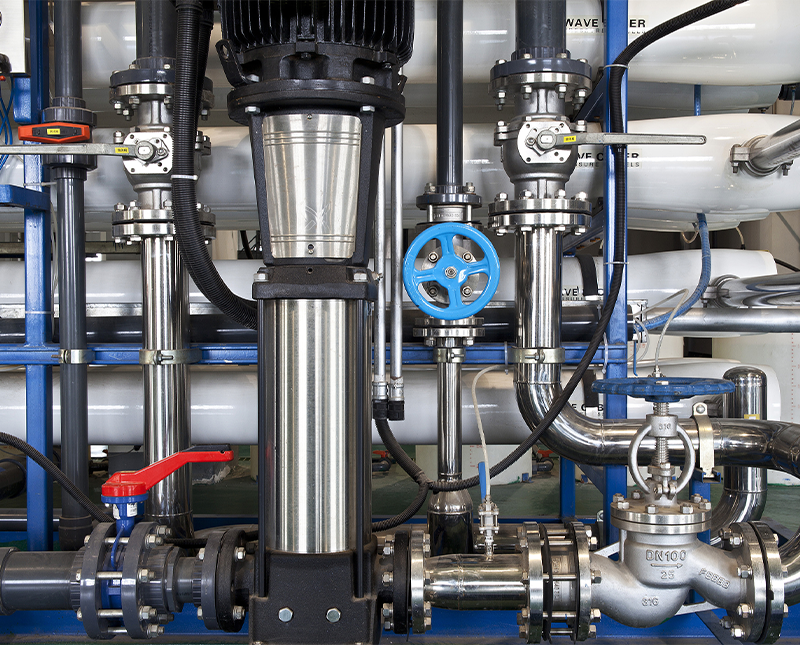

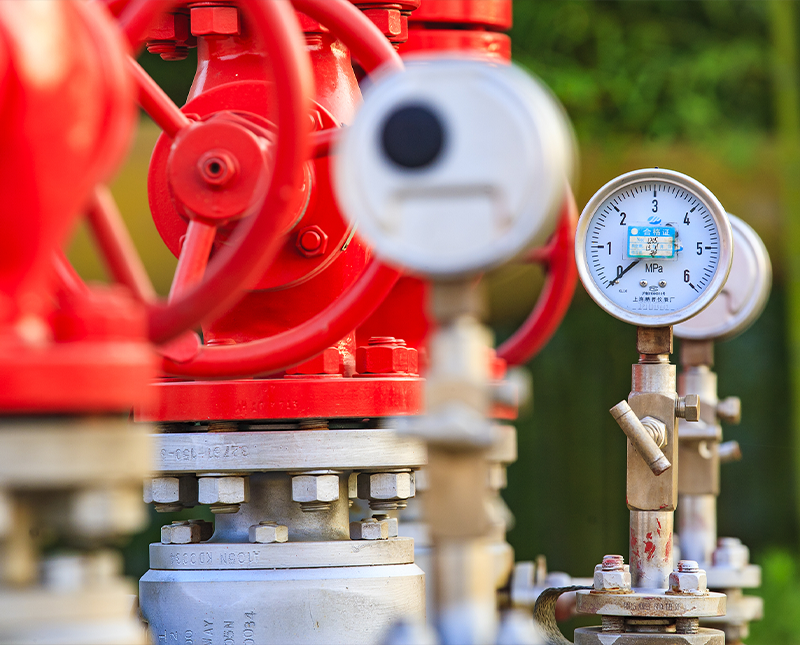
The flow coefficients of control valves in different unit systems (Cv, Kv, and C) all refer to the volume of water that a fully open control valve can pass per unit time under a fixed pressure differential. The relationships among Cv, Kv, and C are Cv = 1.156Kv and Cv = 1.167C. This article shares the definitions, units, conversions, and detailed derivation processes of these three coefficients.
1.Definition of Flow Coefficient
The flow capacity of a control valve refers to the volume of fluid passing through the valve per unit time, at a specified temperature and with a unit pressure differential across the valve. It is expressed differently under different unit systems.
① Definition of Flow Coefficient C
At a given travel, when water at 5–40 °C flows through the control valve with a pressure differential of 1 kgf/cm² across the valve, the volume (expressed in m³) passing through per hour.
C is the general symbol for flow coefficient, which has been widely used in China for a long time and was formerly referred to as flow capacity C.
② Definition of Flow Coefficient Kv
At a given travel, when water at 5–40 °C flows through the control valve with a pressure differential of 102 kPa across the valve, the volume (expressed in m³) passing through per hour.
Kv is the flow coefficient in the International System of Units (SI).
③ Definition of Flow Coefficient Cv
At a given travel, when water at 60 °F flows through the control valve with a pressure differential of 1 psi (1 lb/in²) across the valve, the volume (expressed in U.S. gallons) passing through per minute.
Cv is the flow coefficient in the Imperial system.
2.Derivation of Formulas for Different Unit Systems
①Formula and Units of Flow Capacity C (Chinese conventional unit system)
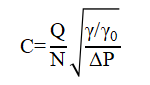
When γ/γ₀ = 1, Q = 1 m³/h, and ΔP = 1 kgf/cm², if C is defined as 1, then N = 1.
The formula and units of flow capacity C are as follows:
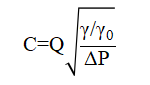
In the formula, C is the flow capacity; Q is in m³/h; γ/γ₀ is the specific gravity; ΔP is in kgf/cm².
② Calculation Formula and Units of Flow Coefficient Cv
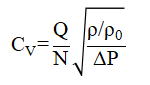
When ρ/ρ₀ = 1, Q = 1 US gal/min, and ΔP = 1 lb/in², if Cv is defined as 1, then N = 1.
The formula and units of flow coefficient Cv are as follows:
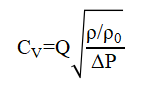
Where: Cv = flow coefficient; Q is in US gal/min; ρ/ρ₀ = relative density; ΔP is in lb/in².
③ Calculation Formula and Units of Flow Coefficient Kv
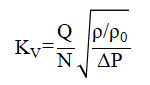
When ρ/ρ₀ = 1, Q = 1 m³/h, and ΔP = 100 kPa, if Kv = 1, then N = 0.1.
The formula and units of flow coefficient Kv are as follows:
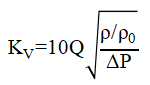
Where: Kv = flow coefficient; Q is in m³/h; ρ/ρ₀ = relative density; ΔP is in kPa.
3. Conversion Between Flow Capacity C, Flow Coefficient Kv and Flow Coefficient Cv
① Relationship Between Flow Coefficient Cv and Flow Capacity C
From the formula 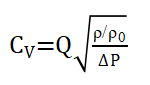 :
:
Q is in US gal/min; ρ/ρ₀ is the relative density; ΔP is in lb/in².
When C = 1, Q = 1 m³/h, γ/γ₀ = 1 (i.e., ρ/ρ₀ = 1), and ΔP = 1 kgf/cm², substituting the condition C = 1 into the calculation formula for Cv yields:
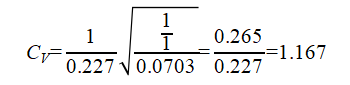
From the calculation result:
C = 1 is equivalent to Cv = 1.167, i.e., Cv = 1.167C.
② Conversion Between Cv and Kv
When Kv = 1, Q = 1 m³/h, ρ/ρ₀ = 1, and ΔP = 100 kPa, substituting these into the calculation formula for Cv and performing unit conversion gives:
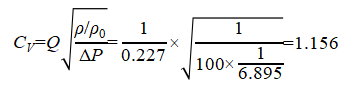
That is, Kv = 1 is equivalent to Cv = 1.156, i.e., Cv = 1.156Kv.
Since some references and catalogs lack the derivation process for control valve flow capacity C, flow coefficient Kv and flow coefficient Cv, confusion often arises in application.
We clarify C, Kv, Cv in terms of their definitions, unit applications and interrelationships, to assist engineering designers in converting and comparing the differently expressed flow coefficients (C, Kv, Cv) during control valve sizing and calculation, thus facilitating the selection and comparison of control valves.