 English
 Deutsch
 Indonesia



Content
- 1 What a Pressure Controlled Valve Actually Does
- 2 Duty Types and the Symptoms Each One Produces
- 3 Reducing Regulator or Relief Valve: Not Interchangeable
- 4 Sizing Numbers That Decide Whether the Loop Settles
- 5 Actuation and Accessories That Keep the Setpoint Honest
- 6 Faults I Check First When a Loop Will Not Hold
- 7 Questions Buyers Ask Before Specifying
A reducing valve that holds 4.2 bar on a steam header at low demand and sags to 3.6 bar when the batch vessel calls for full flow is usually not faulty. It is oversized, under-ranged, or fed by a sensing tap mounted a hand's width from an elbow. Pressure control is a mechanical feedback loop, and every part of that loop can be measured before you place an order: setpoint, droop, rangeability, Cv, and the pressure drop the trim has to absorb.
What a Pressure Controlled Valve Actually Does
A pressure controlled valve holds a target pressure by continuously changing its flow area in response to a pressure signal taken from the line itself. The sensed pressure acts on a diaphragm or piston, that force is balanced against a spring or an instrument-air signal, and the stem moves until the measured pressure returns to the setpoint.
Definition: a pressure controlled valve is a modulating final control element whose opening is positioned by pressure feedback, so the valve absorbs pressure the rest of the system cannot absorb for itself.
That feedback behaviour separates it from a shut-off valve. A ball valve or a gate valve is open or closed; a pressure control valve sits somewhere in the middle and keeps moving. Four parts decide whether the loop behaves or fights itself:
- Sensing element: a diaphragm for low pressures, a piston for high pressures, each with its own temperature ceiling.
- Reference force: a spring in self-operated regulators, a pilot in pilot-operated versions, or a positioner reading a 4-20 mA signal.
- Trim: plug, cage or seat geometry that fixes Cv, leakage class and behaviour at low lift.
- Feedback path: the impulse line, its bore, its length and where it taps into the pipe.
Where the tap sits decides the reading. A downstream tap placed within two pipe diameters of the valve outlet sees turbulence rather than pressure, and the loop answers with a wandering setpoint that no tuning will settle. Take it four to six pipe diameters downstream, on the same line size or one size smaller, and slope it so condensate drains back into the pipe.
Duty Types and the Symptoms Each One Produces
Duty type decides the trim, the failure mode and even the piping, so identify it before opening a catalogue. These four duties account for most of the drawings that cross a valve supplier's desk.
| Duty | What it holds | Usual hardware | Warning symptom |
| Pressure reducing | Lower downstream pressure from a higher upstream source | Self-operated or pilot-operated regulator, cage or single-seat trim | Setpoint sags at peak flow, hissing and seat erosion at high drop |
| Back pressure and relief | Upstream pressure, or protection of a vessel and pump | Spring-loaded relief valve, back-pressure regulator | Chattering, simmering, spring fatigue after repeated lifting |
| Sequence and counterbalance | Minimum pressure that orders motion or holds a load | Sequence valve with internal pilot, counterbalance valve | Jerky cylinder motion, load drift, oil overheating |
| Unloading and bypass | System pressure ceiling by diverting excess flow | Unloading valve, pilot-assisted bypass regulator | Pump runs hot, pressure spikes at start-up, noisy relief |
Relief and regulation are different jobs. A safety valve is sized on the worst credible scenario that follows API 520 and API 521, while a regulator is sized on the normal operating range. Buying one for the other duty is one of the most expensive shortcuts in a pressure loop.
Reducing Regulator or Relief Valve: Not Interchangeable
A reducing valve throttles flow to hold a lower downstream pressure; a relief valve opens to protect equipment once upstream pressure climbs past its set value. They sense opposite sides of the system and they fail in opposite directions.
Pressure-reducing regulator
- Senses downstream pressure through a dedicated impulse line
- Normally open: rising downstream pressure closes the plug
- Sized on normal flow, with a 20 to 30 percent Cv margin
- Setpoint adjustable in service by spring compression
Pressure-relief valve
- Senses upstream pressure at its own inlet, no impulse line needed
- Normally closed: rising inlet pressure lifts the disc
- Sized on the relief scenario, not on normal throughput
- Setpoint fixed by spring selection and usually sealed
Never let a regulator be the only overpressure protection on a line, and never expect a relief valve to hold a steady process pressure. Each device does one job, and the two jobs belong on separate datasheets.
Sizing Numbers That Decide Whether the Loop Settles
Four values carry most of the risk in a sizing sheet, and three of them are usually missing from the enquiry.
Rangeability of a good self-operated regulator. Below 5:1, expect hunting at low demand.
Droop limit as a share of setpoint for proportional regulators without a pilot.
Minimum differential a pilot-operated regulator needs to stay stable.
Seat leakage normally specified for soft-seated control trims below 200 C.
Work through the sequence in order, because each step constrains the next one:
- Fix the setpoint band rather than a single number, and state how much deviation the process tolerates.
- Calculate the required Cv from maximum flow at the minimum differential the system can offer.
- Check the pressure drop ratio against vapour pressure, since flashing destroys trim that cavitation only wears.
- Check turn-down against minimum flow, because an oversized valve hunts and erodes its own seat.
- Confirm body material, elastomer and diaphragm rating against the real medium and temperature.
Cavitation check: when the drop pushes the vena contracta below vapour pressure and the outlet stays above it, bubbles collapse on the trim. Downstream pressure recovery, staged cage trim and hardened seat materials decide how many months the seat survives, but only staged trim removes the cause.
Actuation and Accessories That Keep the Setpoint Honest
Three actuation routes cover almost every plant case, and the choice is usually made by what is available on site rather than by control theory.
Self-operated regulators where air and power are missing
Where there is no instrument air and no reliable power, a self-operated regulator is the honest answer: line pressure works against a spring, so the valve needs nothing but the process itself. Control quality is proportional, so expect the outlet to sit 5 to 10 percent below setpoint at full flow. Choose the spring range so the working point lands mid-band, and read this guide to self-actuated regulators that hold pressure without instrument air before fixing a setpoint on a line with a variable supply.
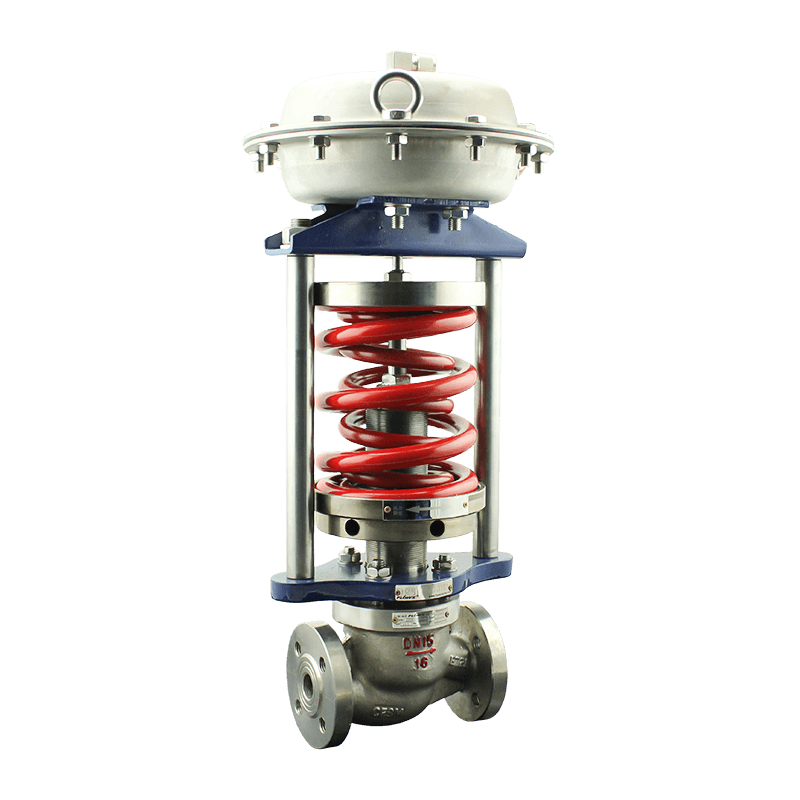 Self-Operated Pressure Control Valve for Air-Free SitesUses process pressure to regulate gas, liquid, or steam without electricity or gas, fitting the no-instrument-air case discussed here.View Product →
Pneumatic valves with a smart positioner
Instrument air gives the tightest control and the best diagnostics. A pneumatic actuator with a smart positioner closes the loop on stem position, logs travel and flags a sticking stem before product goes out of specification. Specify dry, filtered air at 4 to 6 bar, because more pneumatic faults come from wet air than from worn trim. Shop the valve positioners by actuator stroke, not by price alone.
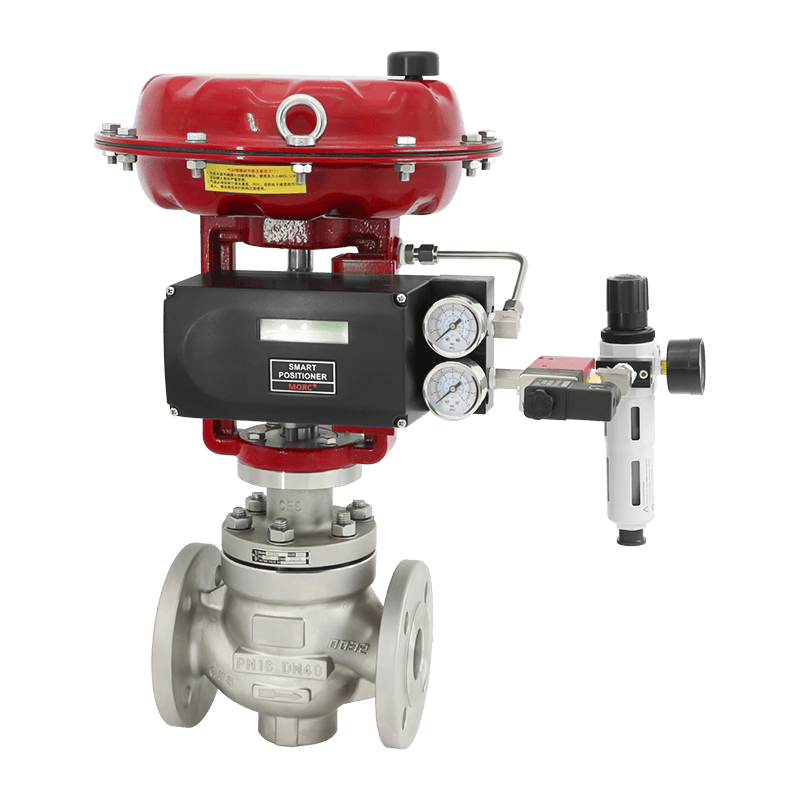 Pneumatic Precise Flow Control Valve for Liquid and GasSingle-seat or sleeve pneumatic valve for precise flow control, with diaphragm actuator and air source pressure stated at 3.5 bar.View Product →
Electric actuators for remote and classified areas
Electric actuation suits sites without an air header, long pipelines and hazardous areas. Explosion-proof electric actuators with a modulating card and a 4-20 mA input handle pressure control on remote wellheads and tank farms. Response is slower than pneumatics, so keep them for loops with slow process dynamics.
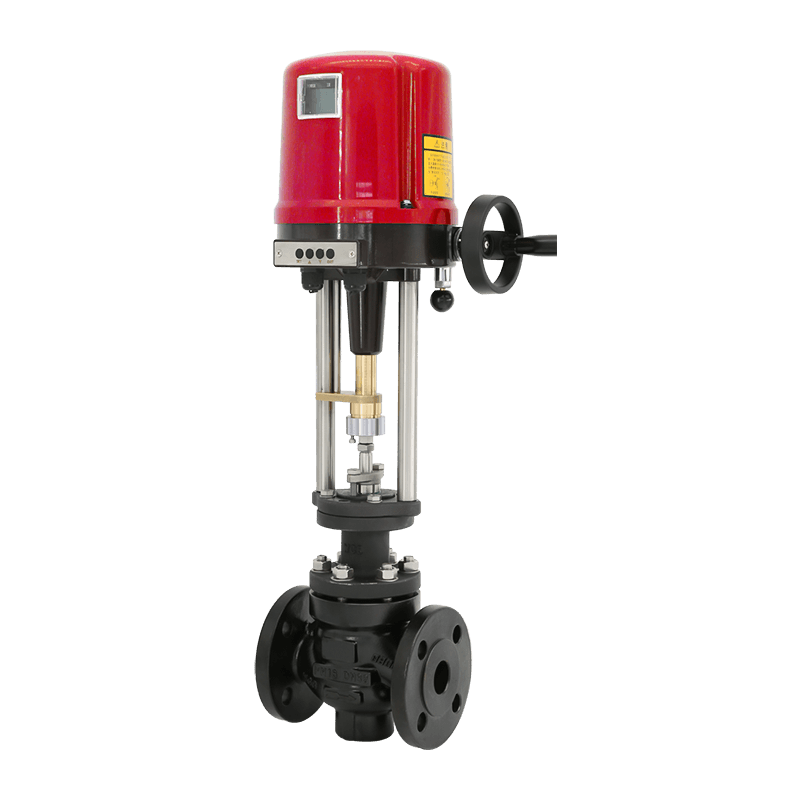 Electric Smart Control Valve with Intelligent ActuatorSupports 4-20 mA input/output and linear stroke adjustment for precise electric flow regulation where instrument air is unavailable.View Product →
Match the actuator to process speed, not to the purchase order. A fast actuator on a slow loop amplifies every bit of sensor noise.
Faults I Check First When a Loop Will Not Hold
Roughly a third of the pressure complaints that reach a supplier are traced to the sensing line rather than the valve body. These are the causes worth checking, in this order.
Before changing the valve, read pressure at the tap with a calibrated gauge. If the gauge is steady while the valve hunts, the problem sits downstream of the tap and not in the trim.
Questions Buyers Ask Before Specifying
Is a pressure reducing valve the same as a pressure control valve?
In daily plant language the terms overlap. Pressure control valve is the wider term covering reducing, back-pressure and relief duties; a pressure reducing valve is one member of that family, defined by holding a lower downstream setpoint.
How much pressure drop does a self-operated regulator need?
Budget 0.5 to 1 bar of differential for stable pilot operation and around 1 bar for direct-acting springs. Below that figure the valve runs wide open and the setpoint simply follows upstream pressure.
Can one valve control pressure and flow at the same time?
Not reliably. One trim satisfies one controlled variable, so where both matter, hold pressure with the regulator and measure flow separately, or use a cascade with the flow controller as master.
Which leakage class should I specify for a pressure control trim?
Class IV metal-seated trim covers most steam and hot oil duties. Specify Class VI soft-seated trim for gas, water and clean chemicals below 200 C, and accept that soft seats wear faster in dirty service.
A pressure controlled valve is chosen on three lines of a datasheet: duty, Cv and differential. Everything else, from the actuator to the positioner, exists to hold those three numbers steady across a few thousand hours of service.