 English
 Deutsch
 Indonesia



Content
- 1 What an Electric Globe Valve Actually Is
- 2 Electric or Pneumatic Actuation: Decide Before You Compare Prices
- 3 Why the Globe Body Still Earns Its Seat
- 4 A Procurement Checklist That Prevents Expensive Surprises
- 5 Applications Where Electric Globe Valves Pay Back
- 6 Installation and Maintenance Habits That Extend Service Life
A globe valve fitted with an electric actuator is the right call when one line item has to close drop-tight on demand and still throttle flow within a few percent of setpoint. Ball and butterfly valves usually cost less and waste less pressure, but they give away control authority in the low-lift range where dosing, steam conditioning and pressure letdown actually happen. This article explains what an electric globe valve is, when an electric driver beats a pneumatic one, and which specification details decide whether the assembly runs for a decade or stalls in its first month.
What an Electric Globe Valve Actually Is
The valve body is a classic globe: a disc or plug travels perpendicular to the seat ring, and flow must pass through an S-shaped passage that the seat opening meters. Because the plug moves along the flow axis over many turns instead of a single quarter turn, the relationship between lift and flow can be shaped by the plug profile - linear, equal-percentage, or quick-opening. The electric actuator bolts to the yoke and converts motor rotation into stem travel through a multi-turn gearbox. Inside the housing sit a motor, reduction gearing, travel limit switches, a torque switch and, on modulating versions, a control board that accepts a 4-20 mA or 0-10 V signal and holds intermediate positions steady.
Vatten Valve Group's electric shut-off valve rangeSuppliers catalogue this kind of hardware under two names: on/off duty appears as electric shut-off or stop valves, while throttling duty is sold as electric flow control valves. The range above follows exactly that split, so the first step for any buyer is to define the duty - open-and-close, or throttle - before comparing models.
Electric or Pneumatic Actuation: Decide Before You Compare Prices
Decide the actuation question first, because it changes project cost more than the body style does. Choose electric actuation when the plant has no dependable instrument air, when positioning must repeat within about one percent of stroke, when stroke times of 15 to 60 seconds are acceptable or even helpful for water-hammer control, and on remote skids where a power cable is cheaper than a compressor network. Pneumatic actuation still wins where a mechanical spring must guarantee a fail-open or fail-close position, where stroking in under three seconds matters, or in hazardous areas where plant air avoids heavy explosion-proof electrical enclosures.
| Attribute | Electric actuator | Pneumatic actuator |
|---|---|---|
| Power source | Mains supply, 220 V single-phase or 380 V three-phase | Compressed instrument air, typically 4-7 bar |
| Typical stroke time | 15 seconds to several minutes | Under 1-3 seconds with standard cylinders |
| Positioning accuracy | High with a control board and positioner | Good with a positioner, but sensitive to air quality |
| Fail-safe behaviour | Holds last position unless battery or spring backup is fitted | Inherent fail-open or fail-close with spring return |
| Infrastructure | Cable, starter and switchgear only | Compressor, dryer, filter-regulator and tubing network |
| Maintenance focus | Gearbox lubrication and limit-switch checks | Seals, filter bowls and air-leak hunting |
One practical note on safety: an electric actuator that loses power simply stops and holds its last position. That fail-in-place behaviour suits many dosing and blending duties, but it must be reviewed carefully for fuel lines or any service where a frozen valve position creates a hazard.
Why the Globe Body Still Earns Its Seat
Three characteristics justify the higher pressure drop of the S-shaped flow path. First, throttling stability: a characterized plug produces a predictable flow curve, while ball and butterfly valves have their steepest gain near closure, which makes controllers hunt at small openings. Second, shutoff integrity: machined seat rings and perpendicular plug contact seal tightly at common pressure classes, something metal-seated quarter-turn valves rarely match. Third, cycling tolerance: a globe plug wears evenly across repeated modulating cycles, whereas ball seats tend to score when they are throttled instead of fully opened or closed.
The honest trade-off is pressure drop. Depending on trim and size, a globe body can consume several times the head of a same-bore ball valve, so verify the Kv or Cv margin during design instead of discovering the shortfall at commissioning.
A Procurement Checklist That Prevents Expensive Surprises
Most field problems trace back to five specification decisions rather than to manufacturing defects. Work through them in this order:
- Define the duty class. An actuator rated for short-time on/off service will overheat in continuous modulating service; insist on a modulating rating with an adequate starts-per-hour figure, commonly 600 or more for control duty.
- Size thrust with real numbers. Required closing force equals the maximum differential pressure across the seat times the seat area, plus packing friction, multiplied by a safety factor of roughly 1.3 to 1.5. Undersized actuators stall mid-stroke; grossly oversized ones slam the plug into the seat.
- Match supply and environment. Confirm 220 V single-phase or 380 V three-phase power, IP67 as the outdoor minimum and IP68 where flooding is possible, and explosion-proof enclosures in classified zones.
- Specify body and trim against the medium. WCB carbon steel for steam, oil and water; 316 stainless where chlorides or solvents appear; PTFE-lined bodies for aggressive acids; graphite packing once media temperature passes roughly 200°C, where PTFE packing gives up.
- Lock the control interface early. Agree on 4-20 mA input and feedback, limit and torque alarm contacts, and a smart positioner for control duty, so the valve, actuator and control system speak the same language on delivery day.
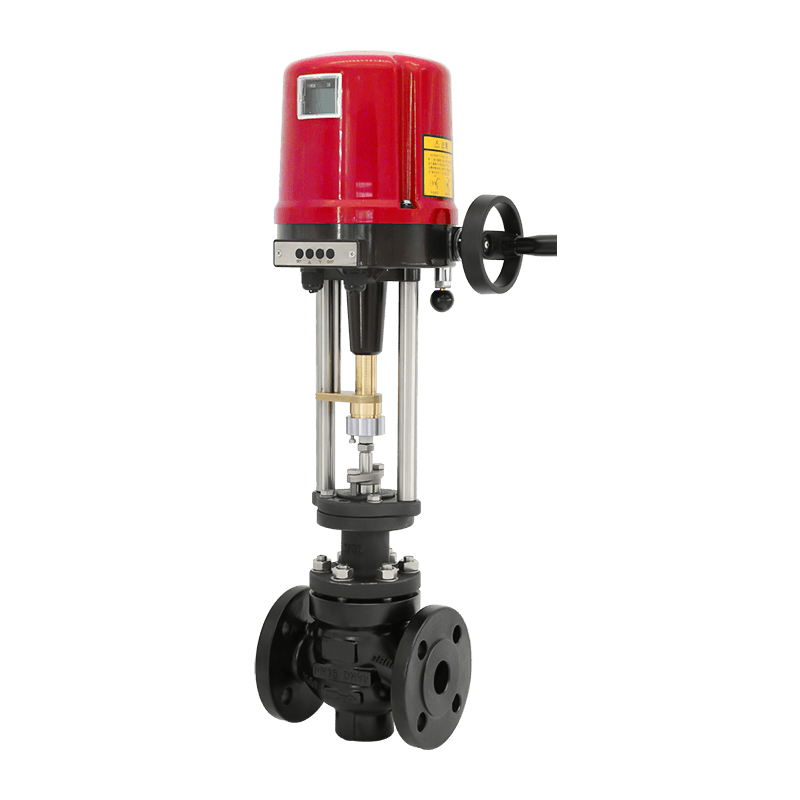 VATTEN Electric Smart Control ValveAn electric control valve with an intelligent actuator, 4-20mA input/output and linear stroke adjustment, offered in WCB and stainless alloys with PN16-PN100 ratings, ideal for readers deciding on specification and integration.View Product →
Integration matters as much as hardware: a valve that ships with its positioner and feedback pre-configured, like the unit above, removes the alignment and wiring errors that come from mixing components from separate suppliers. For deeper sizing math on the modulating versions, the working principles and selection guide for electric flow control valves walks through Kv calculation, rangeability and common failure modes step by step.
Applications Where Electric Globe Valves Pay Back
Electric globe valves earn their price in duties that combine precision with moderate cycle rates:
- Steam pressure reduction and boiler feedwater regulation, where slow, repeatable strokes protect downstream equipment from shock.
- Chemical dosing and pH trim, especially with lined bodies and stainless trim, where a few percent of overshoot can ruin a batch.
- Water and wastewater treatment: coagulant dosing, filter sequencing and backwash throttling, all automatable without an air system.
- Reaction-vessel feed and additive lines in pharmaceutical and fine-chemical plants, where cleanable stainless bodies and precise low-flow control are mandatory.
- New-energy production lines: battery-material plants subject valves to solvent and abrasive slurry duties, and Vatten has documented its valve performance in lithium battery industry service.
Installation and Maintenance Habits That Extend Service Life
Install the valve with its flow arrow respected - on standard stop valves flow normally enters under the plug, so line pressure assists sealing - and keep the actuator upright unless the manufacturer's bracket allows otherwise. Engage the handwheel override only with the motor isolated, and make a manual globe valve in the bypass line standard practice, because it lets commissioning crews flush and stroke the line before any actuator sees duty.
manual carbon steel globe valve for bypass linesAfter start-up, three habits cover most of the lifecycle. Exercise modulating valves through partial travel quarterly so the seats do not lap in. Repack the stem at the first sign of weeping rather than waiting for failure. Re-verify limit and torque settings after every refurbishment, because a correctly set torque switch is what actually protects the seat ring.
Choose the globe body when control precision and drop-tight shutoff justify the pressure drop, choose the electric driver when air supply is absent or repeatability matters more than milliseconds, and then spend the remaining effort on thrust sizing, duty class and materials. Those specification decisions, not the brochure, determine how the valve behaves in year five.